Python, AI, and Chatbots (Brief Overview)
Most AI developers I know use Python as the main programming language for building AI applications. Python is easy to learn and has extensive libraries to work with. Basically, Python is more versatile, accessible, and efficient compared to languages like Java and C++. For example, with Python, I can create a software function with fewer lines than in Java.
Although Python is enjoying the limelight today, the language has been around since the 1990s. I remember coding with Python 15 years ago, long before chatbot was even a thing. Over the years, Python has gone through several changes, but much of its syntax, or coding rules, remains the same.
At its core, Python remains the simple programming language I knew. And today, it’s favored for data science, machine learning, and LLMs. Likewise, chatbots have advanced leaps and bounds over the years. They went from simple, limited Q&A bots to natural conversationalists powered by LLMs like Generative Pre-trained Transformer (GPT).
But can you create an AI chatbot with Python without extensive programming experience? Well, with today’s technologies, you can. And that’s what I hope to show in the sections below.
What are Python AI chatbots?
Python AI chatbots are software applications designed to simulate human-like conversation using natural language processing (NLP). These intelligent bots can understand and respond to text or voice inputs in natural language.
Modern AI chatbots are often powered by LLMs, which are trained from volumes of conversational and linguistic data. This gives the chatbot exceptional NLP capability that exceeds the limits of previous machine learning or rule-based chatbots. Instead of relying on scripts, modern AI chatbots can converse and reason in real time just like humans do.
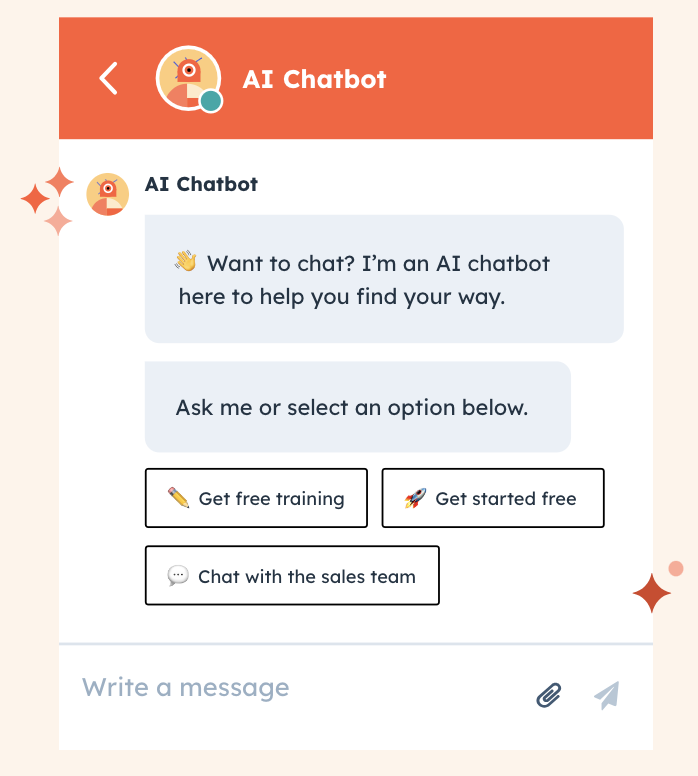
Free AI Chatbot Builder
Qualify leads, book meetings, provide customer support, and scale your one-to-one conversations — all with AI-powered chatbots.
- Create chatbots in minutes
- Support customers 24/7
- Qualify leads & book meetings
- And more!
For example, ChatGPT, the generative AI interface many of us are familiar with, is powered by GPT. It also becomes the foundation of many business chatbot applications, including providing seamless customer service, answering queries, or even making product recommendations.
So, how does Python fit in?
Python plays a crucial role in creating and repurposing AI chatbots for various use cases. I like to think of Python as the glue that brings every AI and software feature together. With Python, you can:
- Use available AI libraries (e.g., OpenAI, transformers, spaCy).
- Build conversational logics.
- Connect with business functions.
- Integrate the chatbot algorithm with web apps.
Benefits of Using Chatbots
Here are some of the advantages of using chatbots I’ve discovered and how they’re changing business dynamics.
Prompt Customer Service
Chatbots can pick up the slack when your human customer reps are flooded with customer queries. These bots can handle multiple queries simultaneously and work around the clock. Instead of putting customers on hold or tackling queues of support tickets, chatbots help accelerate problem resolutions.
Simplify Your Staffing Needs
Some AI chatbots have strong reasoning capabilities. When connected to your company’s knowledge base, chatbots can resolve simple queries and redirect complex ones to human personnel. Let’s say a customer needs help to set up a product. They can ask their question, and the chatbot will direct them to a step-by-step video guide.
For startups and small businesses, this allows you to scale your customer service operations without growing beyond your budget. You can keep your team lean until you secure enough capital to grow.
Increased Revenue
Chatbots can create a hyper-personalized interaction the moment prospects start asking questions. Based on the responses, chatbots can ask qualifying questions, so that you can funnel high-quality leads that are more likely to convert. In addition, you can also use a chatbot to segment customers and direct them to targeted campaigns.
Improved Employee Experience
Chatbots can make your team happier. They can use chatbots to automate routine tasks, which often take up precious time. More importantly, chatbots can be an adept virtual helper, whether for sales, marketing, research, product development, or other business areas.
For example, I use chatbots to resolve coding issues, a task that used to stress me out. And when I face writer’s block, I bounce ideas with a chatbot to unleash my creative flow again.
Types of Chatbots
Before I dive into the technicalities of building your very own Python AI chatbot, let’s explore the different types of chatbots that exist.
Understanding the types of chatbots and their applications helps you determine the best fit for your needs. The choice ultimately depends on your chatbot’s purpose, the complexity of tasks it needs to perform, and the resources available to you.
Rule-Based Chatbots
These chatbots operate based on predetermined rules that they are initially programmed with. They are best for scenarios that require simple query–response conversations. Their downside is that they can't handle complex queries because of limited intelligence. On top of that, rule-based chatbots can’t learn from ongoing interactions.
For example, let’s assume you run an ecommerce website. You can use a rule-based chatbot to do things like:
- Answer frequently asked questions.
- Run a quiz that tells customers about their shopping habits.
- Schedule appointments through a series of questions.
Machine Learning Powered Chatbots
Machine learning (ML) powered chatbots are trained on large datasets, which then lets them interact conversationally with customers.
Unlike rule-based chatbots, ML-powered chatbots are better at conversations. These chatbots are well-suited for complex tasks, but their implementation can be more challenging. Often, you’ll need to fine-tune them before you can use the chatbot for specific business cases.
For example, a machine learning chatbot can show the tracking number when a customer asks, “Can I track my shipment?"



Comments (0)
No comments yet. Be the first to comment!
Leave a Comment